 Benefits & Uses
Top, Middle and Base Impressions: Reading the Scent Journey of a Bergamot, Lavender and Chamomile Blend
Open a bottle of our Calm blend and the first thing that hits you is citrus, bright and almost sparkling. Come back to the same diffuser an hour later and the room smells softer, more floral, even a little fruity. Give it until evening and what's left is warm and quiet, almost apple-like. If you assumed the blend had gone off, or that we'd changed the recipe halfway through the day, you're not wrong to notice the shift. You're just reading it the wrong way. That change is the blend working exactly as designed.
Table of Contents
Key Takeaways
- Bergamot's citrus top note hits first because limonene is light and evaporates fast.
- Lavender's linalool and linalyl acetate hold on longer, so florals settle in as citrus fades.
- Chamomile's heavier sesquiterpenes like alpha-bisabolol linger longest, giving the apple-like base note.
- Slow-release methods like cotton pads skew toward lavender and chamomile since citrus fades fastest in storage.
- Bergamot oil contains bergapten, a photosensitizing compound requiring caution with sun exposure on skin.
Why One Blend Smells Like Three Different Blends
Perfumers have talked about scents in layers — top, middle (or heart), and base notes — since at least the mid-1800s, when English chemist and perfumer Septimus Piesse mapped fragrance intensity onto a musical scale in his 1857 book The Art of Perfumery. The idea held up because it describes something real: different aromatic molecules evaporate at different rates, and a blend reveals its ingredients in roughly the order their molecules leave the bottle (or the skin, or the diffuser reservoir) and reach your nose.
In this blend, that order isn't arbitrary. Cold-pressed bergamot peel oil is dominated by limonene, a small, light monoterpene that makes up something like a third to nearly half of the oil, alongside linalyl acetate and linalool (Tisserand & Young, Essential Oil Safety, 2nd ed., 2014). Small, light molecules have higher vapor pressure, so they flash off fast — that's your top note, the citrus snap you smell in the first few minutes. Steam-distilled lavender (Lavandula angustifolia) leans heavily on linalool and linalyl acetate too, but at concentrations and in a molecular mix that holds on a bit longer, which is why the floral settles in as the citrus fades rather than arriving at the same time. Steam-distilled chamomile (Matricaria chamomilla) brings heavier, slower sesquiterpenes and sesquiterpene alcohols like alpha-bisabolol, plus chamazulene, the compound responsible for German chamomile oil's deep blue color (Tisserand & Young, 2014). Those larger molecules are in no hurry to evaporate, so chamomile's gentle, apple-ish warmth is what lingers last and longest.
None of this is a flaw in a blend — it's the whole point of combining oils with different volatility instead of just mixing citrus, floral, and herbaceous notes that would all announce themselves at once and then vanish together. A blend that smelled identical at minute one and hour three would actually be the less interesting, less carefully built product.
Letting the Notes Decide How You Use It
Once you know which note shows up when, you can choose a method based on which part of that journey you actually want. A quick spritz from a room spray mostly hands you the top note; by the time you'd notice the base, the mist has already settled and thinned out. A diffuser running for a few hours gives the full arc, bergamot first, lavender through the middle stretch, chamomile by the time you're winding down for the evening, which is part of why many people keep this blend running near a living room or office diffuser for everyday scenting rather than saving it for a single burst of fragrance.
Anything with a slower release — a cotton pad, a bar of soap, a candle — behaves differently again, because the citrus top note fades early even in storage, so what you actually smell days or weeks later skews toward the longer-lived lavender and chamomile. That's worth knowing if you're after a sachet that still smells like something in three weeks: expect warmth and florals, not the bright citrus opening you got on day one.
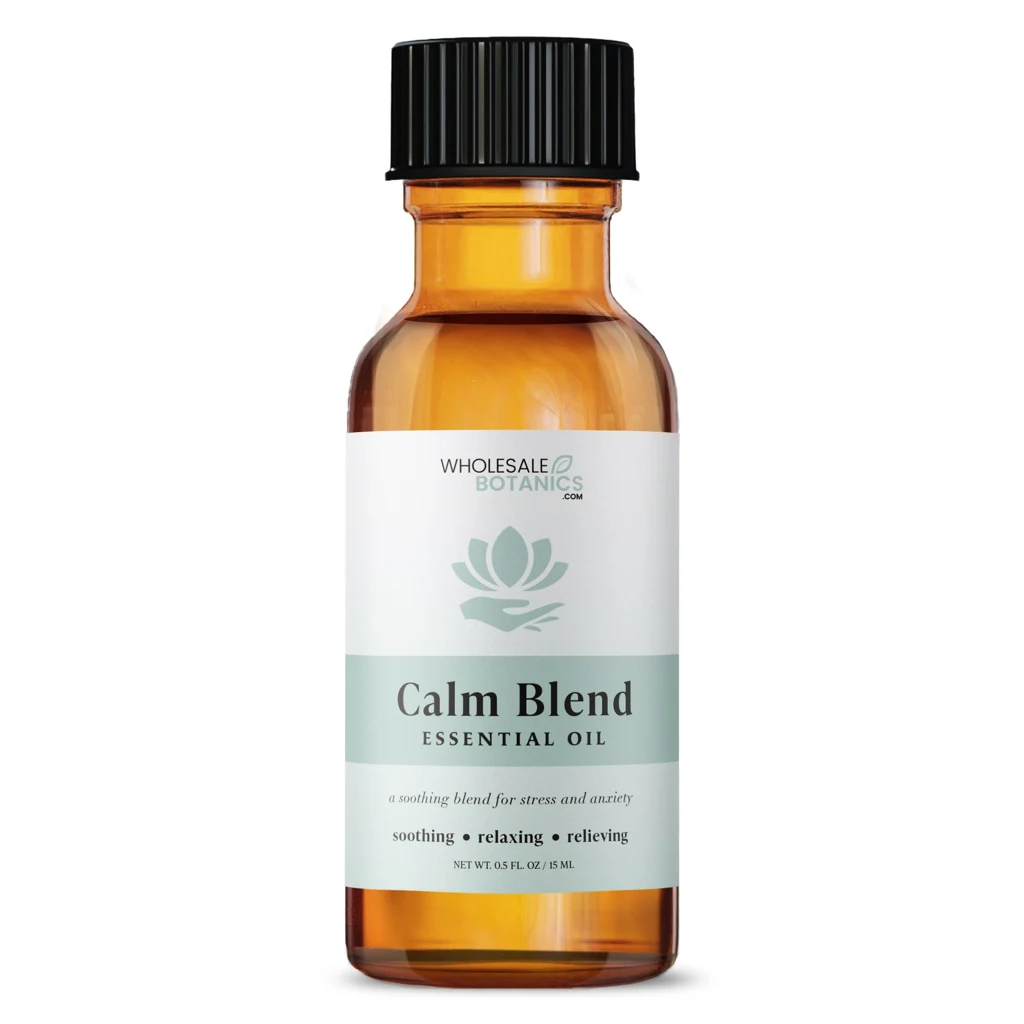
Ready to try Calm Essential Oil Blend?
Sold in sizes from 0.5 oz to 16 oz, lab-tested and shipped fast.
Shop Calm Essential Oil BlendPutting the Blend to Work
A few straightforward ways to use it, matched to what you want out of each:
- Diffuser, for the full journey. This is where the top-to-base arc is most obvious over the course of a few hours. It also pairs well with cedarwood, vanilla, or sandalwood if you want to round out the base even further.
- Soap or candle wax, for a slow release. Stir a small amount into melted soap base or a batch of candle wax and the fragrance carries into the finished goods, skewing toward the longer-lasting middle and base notes once it's set.
- A scented cotton pad, for passive scenting. Tucked into a dresser drawer or gym bag, it keeps working for weeks, mostly on lavender and chamomile's staying power rather than bergamot's.
- Lotion or a simple room mist, for something lighter. A few drops into unscented lotion, or into a spray bottle with witch hazel and water, gives a softer, shorter-lived version of the same blend.
You'll find the Calm Essential Oil Blend made this way in small batches: lavender and chamomile each steam-distilled on their own, bergamot peel cold-pressed separately, then the three combined in careful proportions so the blend reads as rounded and herbaceous rather than sharp or sweet.
Where to Be Careful
Cold-pressed bergamot oil contains bergapten, a furocoumarin that's well documented as photosensitizing: applied to skin and then exposed to UV light, it can increase the skin's reaction to sun, a response studied directly in patch and phototoxicity testing (Kejlová et al., Toxicology in Vitro, 2010). The International Fragrance Association restricts how much bergamot oil containing bergapten can go into leave-on skin products for exactly this reason (IFRA). If you're using this blend on skin rather than in a diffuser or candle, keep it well diluted and out of direct sun for several hours afterward, and check with a dermatologist first if you already have a photosensitivity condition.
Chamomile belongs to the Asteraceae (daisy) family, and people with known allergies to ragweed, daisies, chrysanthemums, or marigolds can show cross-reactive skin or respiratory reactions to chamomile-containing products (Paulsen, Contact Dermatitis, 2002). If that's your allergy history, a patch test or a conversation with an allergist before regular skin use is the sensible step, even though this blend is intended mainly for scenting rooms and finished goods rather than direct application.
This blend also isn't the right pick if what you actually want is a single, unmixed note — straight lavender for its own character, say, or bergamot on its own. Combining the three means none of them performs at full strength the way it would alone, by design. And because the three oils are processed individually before being combined in set proportions, this is a blended product rather than a single-species oil; we don't market or sell it as one.
Frequently Asked Questions
Why does the blend smell different in the morning versus the evening?
Different aromatic molecules evaporate at different rates, so the blend reveals bergamot, lavender, and chamomile in that order. Bergamot's light limonene flashes off first, lavender's linalool holds a bit longer, and chamomile's heavier sesquiterpenes linger last, creating a shifting scent over hours.
Is it a problem if the diffuser scent changes throughout the day?
No, that shift is the blend working as designed, not a sign it's gone off or been reformulated. The top, middle, and base notes are meant to reveal themselves in sequence as different molecules evaporate at different speeds, which the article says makes it a more interesting, carefully built product.
Which method lets me smell the full top-to-base journey of the blend?
A diffuser running for a few hours gives the full arc: bergamot first, lavender through the middle, and chamomile by evening. Quick methods like a room spray mostly give the top note only, since the mist settles before the base note develops.
Why would a scented sachet smell different weeks after I make it?
Because the citrus top note fades early even in storage, a cotton pad or sachet smelled days or weeks later will skew toward the longer-lived lavender and chamomile notes. Expect warmth and florals rather than the bright citrus opening noticed on day one.
Who should be cautious using this blend on skin?
People concerned about sun exposure and those with Asteraceae-family allergies should be cautious. Bergamot's bergapten is photosensitizing, so diluted use and sun avoidance afterward is recommended, and chamomile can cross-react with ragweed, daisy, chrysanthemum, or marigold allergies, per the article's cited sources.
What scents pair well with this blend in a diffuser?
The article notes it pairs well with cedarwood, vanilla, or sandalwood if you want to round out the base even further. It also layers nicely with unscented lotions or candle wax for other uses.